Kindness and Helping Others
East of the MountainsKindness and helping others in the novel take shape through particular acts: listening, tending wounds, finding food, calling for emergency care, and accepting responsibility when a stranger needs help. Ben Givens’s compassion is not presented as a power to undo illness or loss. Instead, it is a willingness to stay with another person’s need and do what the situation permits, even when the outcome remains uncertain.
Care in the Face of What Cannot Be Cured
Ben first encounters the limits of medical care as a boy, when Dr. Williams explains that his mother’s pancreatic cancer cannot be cured. Ben protests that a doctor should be able to help, but Dr. Williams distinguishes medical skill from magic: he wishes he could cure her, yet cannot. The family’s question about how much opium to give her makes the problem more painful. Dr. Williams leaves the amount to them, framing it around how much pain she can bear and when enough is enough. The exchange gives care no clean solution. It requires attention to suffering and difficult judgment precisely where treatment cannot restore health.
Years later, Ben’s response to another person’s pain is shaped by his own capacity and its limits. In a hotel room, isolated by suffering, he eats the food at hand, turns away from television, and reads the Book of Job. The story’s apparent reward of health, long life, wealth, and a renewed family strikes him as too happy an ending; what finally matters to him is that Job, too, dies. The episode does not turn scripture into a comforting explanation for affliction. It places Ben’s reading beside the novel’s repeated acts of care: consolation may not explain suffering, but someone can still attend to the person enduring it.
Care as Skilled, Physical Attention
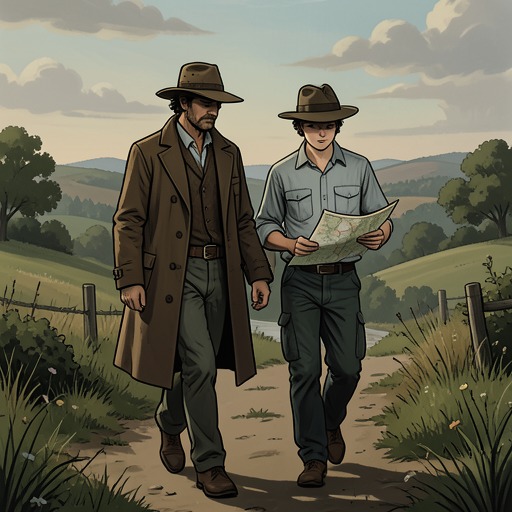
During the desert journey, Ben tends to Rex after the dog has been badly wounded. He uses his medical kit and headlamp to assess the injuries, gently restrains Rex with a makeshift gauze muzzle, and recognizes that the wounds need to be closed before the dog can continue. Ben has field medical experience, but has never stitched a dog. He gathers willow for a fire, tending it while he waits and hoping Tristan will find the blaze unharmed. The scene makes compassion practical and laborious: it involves the animal’s fear, Ben’s limited experience, and the work required before the journey can continue.
At the veterinary clinic, Ben declines to leave Rex in the hands of others. Ilse Peterson explains that Rex will need anesthesia, intravenous support, extensive resuturing, and a stay lasting two or three hours, with a substantial cost. Ben says he will stay and offers whatever help he can. His choice does not replace professional treatment; it makes his presence part of the care surrounding it. The contrast between the improvised treatment in the field and the clinic’s equipment and procedures shows both the usefulness and the limits of what Ben can do alone.
Helping Across Barriers to Medical Care
On the Greyhound, Ben and Catherine Donnelly encounter a seriously ill young picker traveling with two companions. Ben recognizes that he cannot diagnose or treat the young man: he is on the bus without even a stethoscope. He nevertheless tells Catherine that the man needs a clinic or hospital as soon as they reach Wenatchee. Her concern is that hospital staff may ask for identification or immigration papers and that the young man could be deported. Their disagreement makes the need for care inseparable from the risks attached to seeking it.
When the young man coughs up blood at the bus station, Ben calls emergency services and identifies himself as a doctor. He describes the situation as an emergency, gives the location at First and Chelan, and answers the operator’s questions until an ambulance arrives. He directs the emergency technicians to the patient and explains why he believes immediate assessment is needed. The episode presents help as advocacy as well as medical judgment: Ben has no equipment to treat the young man, but he can make the urgency legible to the people who do.
Cost and family responsibility complicate the transfer. Catherine explains that the young man’s brother will not let Angel go because he feels responsible for him and fears that they cannot afford hospital care. Ben insists that the brothers will not have to pay, even as one of the emergency technicians cautions that payment is an issue. Ben argues that federal assistance is available and that treatment matters most. The narrative does not erase the disagreement; it shows his effort to overcome a barrier that could otherwise keep Angel from care. Angel’s brother gets into the ambulance with him, but the third boy is not allowed to ride. Ben watches the ambulance leave and remains with the boy left behind.
Ben then notices the boy’s worn shoes, tattered plastic bags, and evident exhaustion. Using a dictionary and halting Spanish, he asks whether the boy is hungry and takes him to a restaurant on Wenatchee Avenue. He orders a steak-and-potato meal while the boy eats, and learns that he is Emilio, who had met the other two pickers while seeking work. Emilio has no surname to offer and still wants a job. The encounter begins with the immediate need for food, but Ben’s willingness to remain with him gives the abandoned traveler company as well as a meal.
Care in Emergencies and Ordinary Acts
Later, when Ben is ill and cold, Emilio brings stove wood, places Ben’s rucksack on a chair, covers his legs with a blanket, and builds a warming fire. He also lights a candle and attends to the stove. The exchange reverses the direction of assistance: the person Ben helped now tends to him. The gestures are modest, but their sequence matters. Emilio’s care is attentive to the room and to Ben’s condition, and it answers an earlier kindness without turning the relationship into a transaction.
Ben’s response to Doris’s difficult labor shows another kind of care: action under pressure, tempered by awareness of his limits. He has not attended a birth since his internship in obstetrics, where he assisted with deliveries for six weeks in 1954. At first he says that an ambulance is needed and that Doris should go to a hospital. When he sees that the baby’s head is showing, he understands that there is no time to reach one. He helps deliver the baby, checks the mother afterward, and advises Jimmy Perez to take Doris and the newborn to a doctor as soon as possible. His intervention brings the immediate emergency to a safer point; it does not make follow-up care unnecessary. The glass-eyed woman thanks him, and Jimmy calls the birth a miracle, but Ben’s attention remains practical: both mother and baby should be examined, and Doris needs stitches.
Near the end, Ben offers to drive a woman across despite her warning that the distance is long and her reminder that he does not know her. He calls himself a good Samaritan and says that not knowing her does not matter. She goes to tell her husband, who is somewhere in the orchard, that she plans to drive him. The exchange condenses the novel’s ethic into a decision rather than a declaration: assistance need not depend on prior intimacy. Across illness, injury, hunger, and emergency, kindness is not a promise that suffering will end. It is the choice to notice another person, to offer what can be offered, and, when possible, to remain present.